


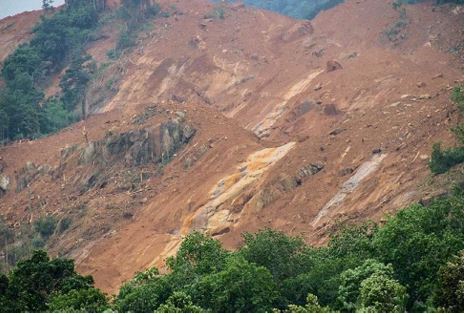
Photo by Redcross, Sri Lanka https://www.redcross.lk/main-news/180-persons-rescued-from-aranayaka-landslide-rescue-missions-well-underway/
By Ananda Wickramasinghe
In late November 2025, Cyclonic Storm Ditwah stalled over Sri Lanka, unloading a deluge that would trigger one of the most devastating landslide events in recent memory. While the immediate toll—lives lost, homes destroyed, families displaced—captured the nation’s heartbreak, a slower-moving disaster is now unfolding on the denuded slopes of the central highlands. Unless urgent action is taken, the environmental aftermath could threaten the very infrastructure that powers the country’s economy for decades to come.
The storm’s relentless rainfall saturated the steep, fragile terrain of districts like Badulla, Matale, Nuwara Eliya, and Kegalle, triggering an estimated 1,200 landslides. According to data from the UNOSAT Geodata platform, these events scarred approximately 2,200 hectares of land. Kandy District bore the brunt with 618 hectares impacted, followed by Nuwara Eliya (507 ha), Badulla (434 ha), and Matale (262 ha).
These are not just blemishes on the landscape. The landslides have violently stripped hillsides of vegetation and fertile topsoil, leaving behind expanses of bare, compacted earth. In this state, the ground acts like concrete. Instead of absorbing rainfall, water rushes off the surface, carrying massive amounts of sediment with it.
This leads to a critical, and largely overlooked, threat: the siltation of Sri Lanka’s lifeblood—its major multipurpose reservoirs. Many of the landslide sites are located within the catchment areas of critical dams, including Kotmale, Victoria, Randenigala, and Moragahakanda. The sediment washing into these reservoirs accelerates siltation, which slowly but surely chokes their capacity. This directly undermines hydropower generation, threatens irrigation reliability for farmlands, and degrades water quality for millions downstream.
The Slow Recovery of a Wounded Forest
In a healthy forest, soil stability is maintained by a complex root system that binds the earth, while leaf litter together with the plant cover acts as a shield, absorbing the pounding power of raindrops, significantly reducing the risk of soil particle detachment and subsequent erosion. The exposed slopes are highly susceptible to even moderate rainfall, which carves deep gullies into the hillside and raises the risk of secondary mudflows. These subsequent events can be just as dangerous as the initial landslide, threatening villages, roads, and rivers below.
Nature does attempt to heal these wounds. Grasses and shrubs slowly creep in from the edges. But on poor, unstable soil, this natural regeneration is a process that can take centuries. Sri Lanka cannot afford to wait that long.
A Blueprint for Rapid Intervention
The solution, experts argue, lies in rapid revegetation. Re-establishing plant cover is the most effective, and most urgent, way to stabilize these fragile slopes. Plant roots bind the soil, leaves break the fall of rain, and organic matter slows runoff, allowing water to seep back into the ground.
However, replanting a landslide scar is not as simple as scattering seeds. It requires a coordinated strategy, beginning with a thorough geotechnical assessment to identify the most unstable areas. Some locations may require structural reinforcements like check dams or contour terraces to provide a stable foundation. Others need improved drainage to safely divert surface water.
The biological strategy is equally important. The focus must be on native species. In the first one to two years, fast-growing “pioneer” species—grasses, sedges, and nitrogen-fixing plants—are essential to quickly cover the soil, control erosion, and create a nurturing microclimate. Once this initial layer is established, the focus can shift to planting slower-growing shrubs and trees that will, over the following five years, build a permanent, resilient forest.
Revegetation Operations: Restoring Stability to Landslide-Scarred Slopes
The method used to restore vegetation after a landslide depends largely on the size of the damaged area and how easily it can be reached. Smaller, accessible scars can often be treated through manual seeding with the support of local labour. But where landslides have carved out vast, steep and unstable slopes, mechanical solutions become essential. In such terrain, hydroseeding has proven to be one of the most effective techniques for rapid slope stabilization.
Hydroseeding involves spraying a carefully prepared mixture of water, seeds, mulch, fertilizers, soil amendments and binding agents onto exposed soil. In landslide zones—where both vegetation and nutrient-rich topsoil have been stripped away—this slurry provides immediate surface protection. The mulch layer softens the impact of heavy rainfall, conserves moisture and regulates soil temperature, while binding agents help the mixture cling to steep gradients. To compensate for lost topsoil, compost, biochar and suitable fertilizers can be added to improve soil structure and nutrient content. Fast-germinating grasses and legumes are typically included to establish quick ground cover, alongside selected native species to support long-term ecological recovery.
Traditional hydroseeding systems use truck-mounted tanks that spray large volumes of slurry through hoses or high-pressure cannons. Operations are most effective when timed with the onset of the main monsoon, when consistent rainfall promotes seed germination—usually within five to fourteen days, depending on the species used.
However, in extensive and inaccessible areas such as the central highlands affected by Cyclonic Storm Ditwah, drone-assisted hydroseeding offers a safer and more practical alternative. With appropriate technical modifications, unmanned aerial vehicles (UAVs) can distribute seed mixtures over unstable terrain without exposing ground crews to hazardous conditions. This approach allows rapid treatment of erosion-prone slopes and can cover tens of hectares in a single day—an important advantage in preventing freshly exposed soils from becoming long-term sediment sources during subsequent rains.
In addition, for hydroseeding drones can also be deployed for targeted broadcasting of grass and tree seeds. These seeds may be coated with soil-binding agents, nutrients and beneficial microbes to enhance establishment success. Similar technologies are already being applied in countries such as Australia, demonstrating their potential to accelerate vegetation recovery while minimizing operational risks.
Modern agricultural and reforestation drones further enhance precision and efficiency. GPS-guided flight paths ensure uniform seed distribution, while variable-rate dispersal enables higher seed densities in high-risk erosion zones identified through slope mapping and modelling. Compared with manual broadcasting or ground-based hydroseeding in remote hill terrain, drone-assisted seeding reduces manpower needs, lowers logistical complexity and minimizes long-term costs. Crucially, it eliminates the need for heavy machinery, preventing additional soil compaction or disturbance of the fragile surface layer essential for seed establishment.
A coordinated national strategy is now urgently needed. Key government institutions—including the Forest, Agriculture and Environmental authorities, together with the National Building Research Organisation—should develop a comprehensive restoration framework that can be applied not only to current landslide-affected areas but also to future events. Successful implementation will require collaboration with international funding agencies, the private sector and local environmental organizations. Without timely and technically sound intervention, landslide scars risk becoming chronic sources of erosion and sedimentation, with lasting consequences for Sri Lanka’s fragile hill country ecosystems.
(The writer is a former research officer attached to the Department of Agriculture, Sri Lanka. Detail report of this article with references and other resources can be found in his blog: https://outofboxag.wordpress.com/. He can be reached at [email protected] )
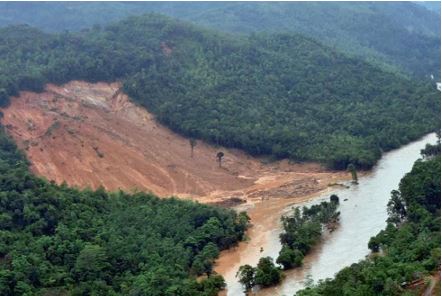
Photo by The Straitstimes Asia